


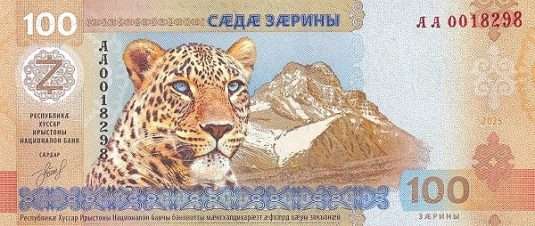
100 Zarins P-1; B-101 Color: Orange, brown and blue Dimensions: 157 x 69 mm
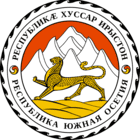
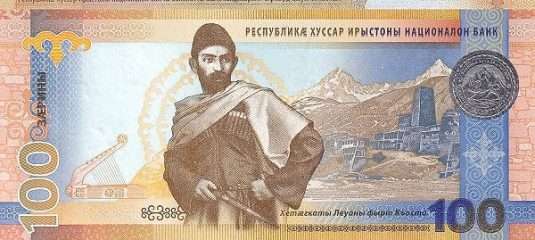
Front: Portrait of Kosta Levanovich Khetagurov, the national poet of Ossetia. To the right of the portrait is the historical village of Nar, while on the left appears an Ossetian twelve-string harp (dyuadæstænon fændyr). The Coat of Arms of South Ossetia is placed in the upper right corner, below it a traditional lilaceous cross symbolizing protection. The denomination “100” is printed in the lower corners. In the upper left corner there is an ornamental element symbolizing farn, meaning all good things gifted by heaven and the sun.
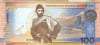
Back: Persian leopard (Panthera pardus tulliana), symbolizing strength and the unique wildlife of the Caucasus. In the background rises Mount Burkhokh, an important natural landmark of South Ossetia. Above left is the graphic symbol of the Zarin currency, giving the note a distinct national identity. The denomination “100” is clearly printed in the upper left and lower right corners for easy recognition. The design combines natural beauty with national symbolism, emphasizing both heritage and independence.
Security thread: Unknown.
Printer: Federal State Unitary Enterprise “Goznak” (Russia) – FGU.
Watermark: Caucasian Anatolian leopard.
Date: 2025. Prefix: AA. Intro: 19.09.2025.
Signature: Soslan Vladimirovich Bekoev.
Printed: 20000.
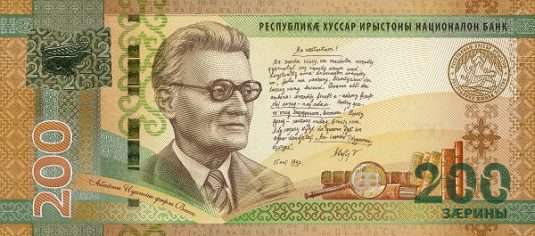
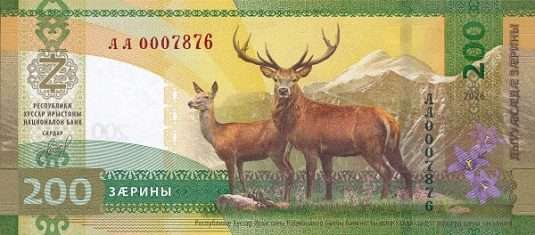
200 Zarins P-2; B-102 Color: Brown, yellow, and green Dimensions: 157 x 69 mm
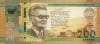
Front: Gold foil open book depicting Scythian deer; Abaityi Yauneyi Fyrt Vasso; Vasso’s handwritten will; magnifying glass showing Ossetian letter æ; books; coat of arms of South Ossetia; lilaceus cross (ancient symbol of protection).
Back: Zarin symbol; female and male Caucasian red deer standing in field; Mount Sanay (Kazbek); Sarmatian bellflowers (Campanula sarmatica).
Security thread: Gold-Windowed security thread.
Printer: Federal State Unitary Enterprise “Goznak” (Russia) – FGU.
Watermark: Caucasian red deer and electrotype 200.
Date: 2026. Prefix: AA. Intro: 20.09.2026.
Signature: Soslan Vladimirovich Bekoev.